


Both the CDC and the Mayo Clinic are clear on this: you cannot reliably distinguish flu from COVID-19 based on symptoms alone. The two illnesses share so many clinical features that even experienced clinicians routinely cannot tell them apart without a test. If you are trying to decide whether to isolate, seek care, or start an antiviral, that distinction matters enormously in practical terms. Testing is the only way to get a specific diagnosis, and for people at higher risk, that answer can directly affect whether treatment is started in time.
Why it matters: Antiviral treatment windows are narrow for both illnesses. Flu antivirals work best within 48 hours of symptom onset; COVID-19 antivirals are generally recommended within 5–7 days. Getting the right diagnosis early is not just reassuring — it can change your outcome.
Key Takeaways
Flu and COVID-19 symptoms overlap so significantly that testing is the only reliable way to tell them apart, and for high-risk patients, that distinction directly determines which antiviral to start and how quickly.
| Point | Details |
|---|---|
| Symptoms alone are not enough | Both illnesses share fever, cough, fatigue, and aches; testing is required for an accurate diagnosis. |
| Antiviral windows are narrow | Flu antivirals work best within 48 hours; COVID-19 antivirals are generally recommended within 5–7 days of symptom onset. |
| Know the red flags | Difficulty breathing, chest pain, new confusion, or bluish lips require emergency care immediately. |
| Vaccines are virus-specific | The flu shot and COVID-19 booster do not cross-protect; you need both to reduce risk from each virus. |
| Your Family Walk-In Clinic | Offers same-day flu and COVID-19 testing, flu shots, and antiviral evaluation seven days a week in Lutz, Florida. |
Table of Contents
- What flu vs. COVID-19 symptoms look like when they overlap
- Which symptoms point more toward one virus than the other?
- How long does each illness take to start, and how long does it last?
- How long can you spread each virus to others?
- What tests are available, and when does testing actually change what you do?
- What treatments are available, and why does timing matter so much?
- Who faces the greatest risk of serious illness?
- What should you do at home, and when is it time to get care?
- How can you reduce your risk of getting either illness?
- What happens if you have both viruses at the same time?
- An editorial perspective on what most people get wrong about testing
- Same-day testing and evaluation at Your Family Walk-In Clinic
- Sources
- FAQ
What flu vs. COVID-19 symptoms look like when they overlap
The reason flu vs. COVID-19 symptoms are so difficult to separate by feel alone is that both viruses attack the same respiratory system and trigger many of the same immune responses. The WHO confirms that the two illnesses share a broad set of common symptoms, including:
- Fever or chills
- Cough
- Shortness of breath or difficulty breathing
- Fatigue
- Sore throat
- Runny nose or nasal congestion
- Muscle aches or body aches
- Headache
Vomiting and diarrhea can occur with either illness, though they appear more often in children than in adults. Because this list covers nearly every common respiratory complaint, symptom overlap is the core reason testing is often the only way to know which virus you are dealing with.
Which symptoms point more toward one virus than the other?
Some clinical clues can raise or lower your suspicion, even if they cannot confirm a diagnosis on their own.
| Symptom or Feature | More typical of COVID-19 | More typical of influenza |
|---|---|---|
| Loss of taste or smell | More common | Rare |
| Onset speed | Gradual, variable | Abrupt, often within 1–2 days |
| Fever severity | Variable | Often high and sudden |
| Severe muscle aches | Sometimes | More common |
| Prolonged fatigue | More common | Less common |
| GI symptoms (children) | Sometimes | More common |
According to the WHO, loss of taste or smell is more commonly associated with COVID-19 than with influenza. Flu, by contrast, tends to announce itself fast: many people describe abrupt onset of symptoms with high fever and intense muscle aches as common features.
Pro Tip: If you notice a sudden, complete loss of taste or smell (called anosmia), that raises clinical suspicion for COVID-19 — but it does not confirm it. Test anyway, especially if you are in a higher-risk group or need to make treatment decisions.
How long does each illness take to start, and how long does it last?
Timing is one of the more useful clinical clues, even if it still cannot replace a test.

| Illness | Incubation period | Typical symptom duration |
|---|---|---|
| Influenza | 1–4 days after exposure | Most people improve within about a week |
| SARS-CoV-2 (COVID-19) | 2–14 days after exposure (commonly 2–5 days) | Symptoms can linger longer; some people develop Long COVID |
Flu tends to hit hard and resolve relatively quickly. Most otherwise healthy adults feel significantly better within about a week, though fatigue can linger a bit longer.
COVID-19 is more variable. Some people recover in a similar timeframe, while others experience symptoms that persist for weeks. A distinct subset goes on to develop Long COVID, a condition involving fatigue, brain fog, and other symptoms that can last months. The Mayo Clinic notes that COVID-19 has tended to show a higher mortality rate than seasonal flu and carries a distinct long-term complication profile that influenza does not.
Knowing your likely exposure date can help you estimate which incubation window fits. If you developed symptoms two days after a known exposure, flu is more consistent with that timeline. If it was five or more days later, SARS-CoV-2 becomes more plausible.
How long can you spread each virus to others?
Understanding the contagious period helps you protect the people around you, not just yourself.
Influenza contagious period:
- Spreads starting about one day before symptoms appear
- Most infectious during the first one to two days after symptom onset
- Adults are generally contagious for about five to seven days total
COVID-19 contagious period:
- Can spread before symptoms begin, sometimes two or more days before
- The contagious window tends to be longer and more variable than flu
- People who are immunocompromised may remain infectious for an extended period
Isolation note: Because both viruses spread before symptoms appear, waiting until you feel sick to isolate means you may have already exposed others. If you have been in close contact with a confirmed case, consider masking and limiting contact even before symptoms start.
The longer and less predictable contagious window for COVID-19 is one reason testing matters for household decisions. Knowing which virus you have can help you determine how long to isolate, when to test before returning to work or school, and whether household members need to take additional precautions.
What tests are available, and when does testing actually change what you do?
Testing is not just a formality. According to the NFID, a specific diagnosis determines whether you should start oseltamivir for influenza or nirmatrelvir/ritonavir for COVID-19, and when empiric therapy for high-risk patients is appropriate. The right test at the right time can open or close that treatment window.
Types of tests available
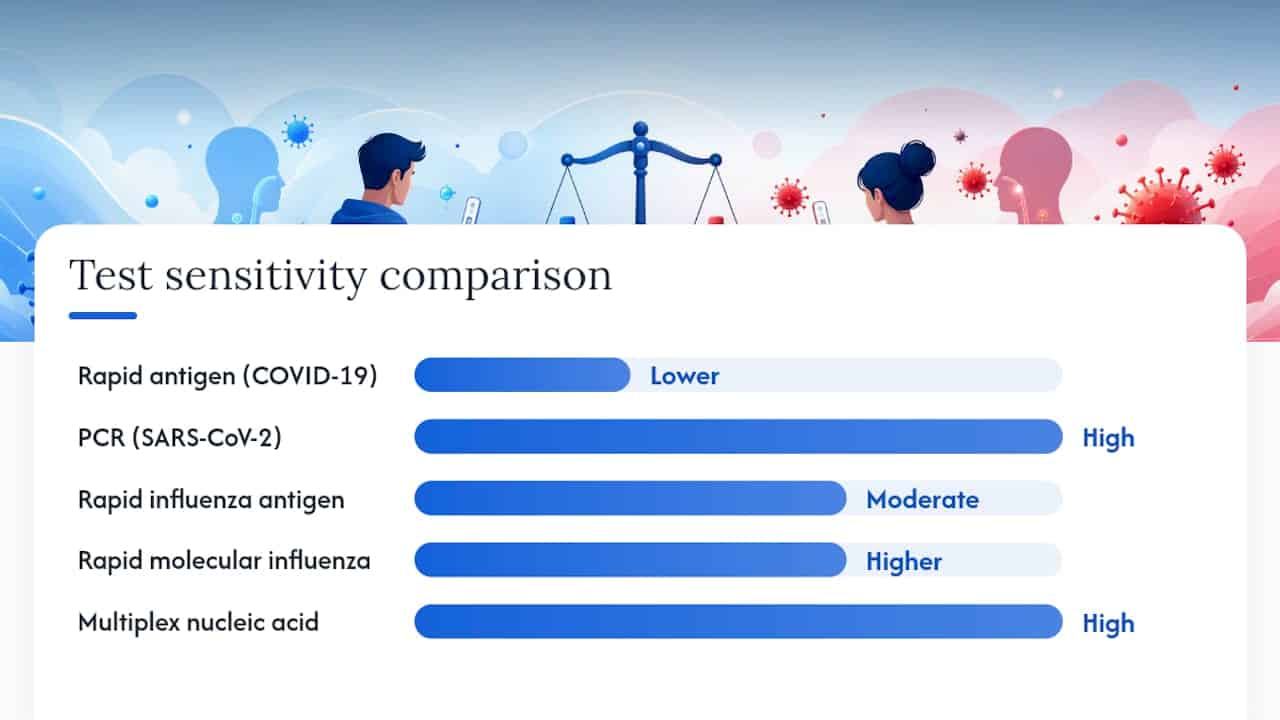
- Rapid antigen test (SARS-CoV-2 antigen): Fast results, often within 15–30 minutes. Widely available at home and in clinics. Less sensitive than molecular tests, meaning false negatives are possible, especially early in infection.
- PCR / nucleic acid amplification test (SARS-CoV-2 PCR): More sensitive than antigen tests. Usually processed in a lab, with results in hours to a day or more. The preferred test when clinical suspicion is high and a rapid antigen is negative.
- Rapid influenza diagnostic tests: Detect influenza A and B antigens quickly, but sensitivity varies.
- Rapid molecular influenza assays: Faster than lab PCR with better sensitivity than antigen tests.
- Multiplex nucleic acid test for SARS-CoV-2 and influenza: Detects both viruses simultaneously from a single sample. Particularly useful when both are circulating in the community, or when co-infection is a concern.
| Test type | Speed | Sensitivity | Best use |
|---|---|---|---|
| Rapid antigen (COVID-19) | 15–30 min | Lower | First-line screening, home use |
| PCR (SARS-CoV-2) | Hours to 1+ day | High | Confirmatory, high-risk patients |
| Rapid influenza antigen | 15–30 min | Moderate | Flu screening when flu is circulating |
| Multiplex nucleic acid | Hours | High | Both viruses circulating; co-infection concern |
CDC guidance on antigen testing confirms that a negative rapid antigen result does not rule out infection when clinical suspicion is high. Serial antigen testing or confirmatory PCR may be needed for high-risk patients or during periods of high community prevalence.
Pro Tip: If your rapid antigen test is negative but you have symptoms consistent with COVID-19 and a known exposure, repeat the antigen test 48 hours later or ask your clinician about PCR confirmation — especially if you are in a higher-risk group where treatment decisions depend on the result.
What treatments are available, and why does timing matter so much?
Antivirals for both illnesses exist, but they work only when started early. The CDC’s clinical guidance states that early antiviral therapy reduces the risk of progression to severe disease for eligible COVID-19 patients and shortens illness or reduces complications for influenza when started promptly.
For influenza:
- Oseltamivir (Tamiflu): Most effective when started within 48 hours of symptom onset. For high-risk patients or those with progressive disease, clinicians may still consider it beyond that window.
For COVID-19:
- Nirmatrelvir/ritonavir (Paxlovid): An oral antiviral generally recommended within five days of symptom onset for eligible patients. Significant drug interactions require clinician review before prescribing.
- Remdesivir: An intravenous antiviral used in certain outpatient and inpatient settings.
- Molnupiravir: An oral antiviral option for COVID-19 when other treatments are not suitable.
Practical considerations before starting antivirals:
- Paxlovid has multiple significant drug interactions, including with common medications like statins and blood thinners. A clinician must review your full medication list.
- Pregnancy affects which antivirals are appropriate for both flu and COVID-19.
- For high-risk patients, the CDC notes that empiric treatment can be started based on clinical suspicion without waiting for test results when a delay would reduce benefit.
The core message: if you are at higher risk and develop symptoms, contact a clinician the same day. Do not wait to see if you get better on your own.
Who faces the greatest risk of serious illness?
Both illnesses can range from mild to severe, but certain groups face a meaningfully higher probability of complications, hospitalization, or death.
Higher-risk groups for both influenza and COVID-19:
- Adults 65 and older
- Young children, particularly those under 5
- Pregnant people
- People with chronic lung disease (asthma, COPD)
- People with heart disease or diabetes
- People with kidney or liver disease
- Immunocompromised individuals (from illness or medication)
Complications to watch for include pneumonia, acute respiratory failure, and hospitalization. COVID-19 carries the additional risk of Long COVID, which can affect people across the severity spectrum, including those who had relatively mild initial illness. Having multiple risk factors compounds the probability of severe disease, which is why clinicians weigh the full picture rather than any single factor.
What should you do at home, and when is it time to get care?
Most mild cases of flu or COVID-19 can be managed at home with supportive care. Here is a practical framework for deciding what to do next.
Home care basics:
- Rest and stay hydrated
- Use acetaminophen or ibuprofen to manage fever and body aches
- Wear a mask around household members if you cannot isolate completely
- Use a separate sleeping area when possible
- Clean high-touch surfaces regularly
Escalating your response:
- Manage at home if symptoms are mild, you are not in a high-risk group, and you are improving.
- Contact a clinician if you are in a high-risk group, symptoms are worsening after two to three days, or you need antiviral evaluation. For guidance on when to see your provider during flu season, early contact is almost always better than waiting.
- Go to emergency care immediately if you experience any of the following red flags.
Red flags requiring urgent or emergency care:
- Difficulty breathing or shortness of breath that is worsening
- Chest pain or pressure
- New confusion or altered mental status
- Inability to wake or stay awake
- Bluish lips or face
- Persistent high fever that does not respond to medication
- Severe dehydration (no urination, dizziness, dry mouth)
These symptoms should never be ignored. Medical groups advise that worsening shortness of breath, chest pain, persistent fever, or confusion warrant prompt professional evaluation without delay.
How can you reduce your risk of getting either illness?
Prevention is the most effective tool available for both flu and COVID-19, and vaccination sits at the top of that list.
Vaccination:
- The annual flu vaccine is recommended for everyone six months and older.
- Updated COVID-19 boosters are recommended for eligible groups each season.
- Flu shots and COVID-19 vaccines are virus-specific. Getting one does not protect you against the other. The WHO confirms that staying current on each recommended vaccine is the most effective way to reduce risk of severe disease from each virus.
Everyday prevention steps:
- Wash hands frequently with soap and water for at least 20 seconds
- Mask in crowded or high-risk indoor settings, especially during peak season
- Improve indoor ventilation when possible
- Stay home when you are sick
- Follow evidence-based steps to reduce COVID-19 exposure
Vaccine reminder: Both flu shots and COVID-19 boosters are available at local clinics. Getting vaccinated before peak season gives your immune system time to build protection before you are exposed.
What happens if you have both viruses at the same time?
Co-infection with influenza and SARS-CoV-2 is possible and has been documented. It is not common, but it is not rare enough to dismiss, particularly during periods when both viruses are circulating actively.
- A positive test for one virus does not exclude the other. If you test positive for flu but your symptoms seem unusually severe or prolonged, co-infection is worth considering.
- Multiplex nucleic acid testing is the most reliable way to detect both viruses from a single sample, which is why clinicians often prefer it when both are circulating in the community.
- Co-infection may increase the risk of severe illness compared with either infection alone, which makes accurate diagnosis and prompt treatment even more important.
- If co-infection is confirmed, treatment decisions become more complex. A clinician may recommend treating for both viruses when clinically appropriate, weighing the timing of symptom onset and the patient’s risk profile.
An editorial perspective on what most people get wrong about testing
Most people think of testing as something you do to satisfy curiosity or to comply with a workplace policy. That framing misses the real point entirely.
Testing changes what happens next. Clinicians rely on a combination of exposure history, local virus activity, and test results to guide treatment decisions, not symptoms alone. When you know you have influenza, the 48-hour window for oseltamivir becomes urgent. When you know you have COVID-19, the five-day window for Paxlovid becomes the clock you are working against. Waiting two days to see how you feel before calling your clinician can mean the difference between a treatment that works and one that no longer applies.
The other thing people underestimate is the pre-symptomatic spread window. Both viruses can spread before you feel sick. By the time you recognize your symptoms as something worth acting on, you may have already exposed people you care about. Testing early, isolating early, and contacting a clinician early are not overcautious behaviors. For anyone in a higher-risk group, they are the behaviors that prevent hospitalizations.
Same-day testing and evaluation at Your Family Walk-In Clinic
When you need answers quickly, Your Family Walk-In Clinic offers same-day testing and evaluation for both flu and COVID-19, seven days a week from 8 AM to 8 PM. No appointment is needed.

The clinic provides rapid antigen testing, PCR options, and clinical evaluation to help determine whether antiviral treatment is appropriate for your situation. Flu shots are also available as walk-ins throughout the season. If you are in a higher-risk group or your symptoms are worsening, the team can assess your eligibility for oseltamivir, Paxlovid, or other treatments within the critical treatment windows. Visit the urgent care page to check hours, or walk in to the Lutz clinic location for same-day care today.
Sources
- Similarities and Differences between Flu and COVID-19 | Influenza (Flu) | CDC
- Coronavirus disease (COVID-19): Similarities and differences between COVID-19 and Influenza | WHO
- Coronavirus vs. flu: Similarities and differences – Mayo Clinic News Network
- Is it Flu, COVID-19, or RSV? How to Tell the Difference | NFID
This article is general information, not a substitute for advice from a qualified doctor. Consult a qualified healthcare professional about your own circumstances before acting on anything here.
FAQ
Can you tell the difference between flu and COVID-19 without a test?
No. Flu and COVID-19 share so many symptoms that neither patients nor clinicians can reliably distinguish them by symptoms alone.
What is the first noticeable symptom of COVID-19?
Symptoms vary, but fever, fatigue, and cough are among the most common early signs. Loss of taste or smell, when it occurs, is more specific to COVID-19 than to flu, though it does not appear in every case.
How many days does COVID-19 typically last?
Most people with COVID-19 improve within one to two weeks, but symptoms can linger longer than with flu. A subset of patients develops Long COVID, with fatigue, brain fog, and other symptoms persisting for weeks or months.
What are the five stages of flu?
Flu does not follow a universally defined five-stage model. Clinically, it progresses through incubation (1–4 days), acute onset with fever and aches, peak symptoms around days two to three, gradual improvement, and recovery, with most adults feeling significantly better within about a week.
Is it worse to have flu or COVID-19 right now?
Severity depends on individual risk factors more than the virus alone. COVID-19 has tended to carry a higher mortality rate and a distinct long-term complication profile (Long COVID) compared with seasonal flu, per the Mayo Clinic. Your risk level, vaccination status, and access to early antiviral treatment all affect how either illness progresses.